The dawning of the digital era and its exhilaration after the Internet became publicly accessible have had far-reaching global consequences. It has changed society, as well as its various institutions, be it the private sector or public institutions like Education. However, soon after the initial euphoria of the Web with its interlinked hypertext that forms an endless web of rich content, a digital divide became evident. This divide, or exclusion as it is referred to in some circles, is the result of differences in the pace of adoption and the roll-out of required infrastructure. In many instances it is the last mile to the end-user that seems unbridgeable. As with other great 'break throughs' before it, technological advancements such as the Internet exacerbate inequalities, many of which have become the norm ever since the Industrial Revolution. As was the case then, the Digital Divide actually exhilarated the gap exponentially. At the heart of the exclusion of poorer nations is inaccessibility to knowledge and an inability to share in social and economic advancements associated with the Digital Age.
For many, visions of a new, equal, easily accessible virtual world in which all can participate, share knowledge, develop, and increase their capacity for a new kind of wealth generator end in disillusionment. For the most part, developing countries have remained stuck in an industrialised old economic model, unable to become part of and benefit fully from the new economy. In a global economy, these countries provide armies of labourers, but in many instances remain outside the mainstream -- one that is driven by information and knowledge. The world is flat, but flatter in some parts than in others.
The large-scale globalisation that has its roots in Western-style colonisation experienced an unprecedented exhilaration with the introduction of an 'anywhere-anytime' economy, which wheels are oiled by round-the clock trading on a global scale. The 'anywhere, anytime' notion finally morphed into 'everywhere, all the time'. Global supply and consumer chains take 'just-in-time' manufacturing and delivery to new levels. This notion continues to impact every aspect of human society, having created new ways of 'being human' due to our 'always on' state in a highly connected world.
But there are of course parts in the world where previous promises of Utopian existences have resulted in an array of negative and often unwanted long-term consequences. One such corner can be found in South Africa. Here the effects of the Apartheid system (1948-1994) based on its notion of separate development can be found. Like so many other decisions, policies and actions before the notion of separate development was introduced as official state policy after 1948, the lingering effects of failed promises of development and the reality of under-development will be hard to reverse.
A number of events, 'flattened' the world according to Friedman in The World is Flat. With changes in the international arena, such as the end of the Cold War, and the disintegration of the USSR came a new zeitgeist, one that in many respects is intertwined with technological developments associated with the Internet, the Web and an explosion of social media networks since the turn of the 20th Century. These changes also ushered in a new era for South Africa and its people. No longer could the stand-off between the White Regime and the subjugated sections of society along racial lines continue. By 1994 a New South Africa was born, and welcomed into the international arena. However, the world into which it was welcomed had itself changed profoundly. With an end to Apartheid, the homelands that were scattered like bread crumbs all over South Africa were wiped from the map as if by a big hand. The country was once again united and areas like Siyabuswa in Kwa-Ndebele, Venda, and Transkei are part of a united South Africa.
Finally, nearly two decades after the dawning of a new South Africa, a once proud creation of the Apartheid government has been put to new use. The Ndebele College of Education that was meant for 'seperate development' in the once separate homeland of Kwa-Ndebele not too far from Pretoria now houses the new Faculty of Education for the first new university in south Africa since 1994. The campus has aptly been renamed to 'Teacher Education Campus, Siyabuswa'. The academic programme will for four years be the responsibility of the University of Johannesburg. A major sponsor for student fees for the first 100 students is the European Union.


The whole area is characterised by the long-term negative effects of separate '(non-)development' during the years of Apartheid. Under-development and poverty in this typical rural area are exceptionally rife, while the effects of the Digital Divide are evident everywhere, including local schools. However, in the midst of this community a new institution of higher education has been established with the hope of sharing in the spoils of development in a country that is part of a global village. A gate is opening and by becoming part of this global village we too can learn from the locals, many of whom have managed to retain their cultural roots, untouched by a fast-paced modern society.


In Siyabuswa children mostly walk to school, laughing, playing and above all talking to each other without the aid of a cellphone!

Perhaps the local community should not be spoiled by the ills of the Digital Era and the artifacts of a consumer-driven society along Western capitalist lines.

But who is to decide, since I am merely an onlooker through the lenses of my numerous digital devices.

For many, visions of a new, equal, easily accessible virtual world in which all can participate, share knowledge, develop, and increase their capacity for a new kind of wealth generator end in disillusionment. For the most part, developing countries have remained stuck in an industrialised old economic model, unable to become part of and benefit fully from the new economy. In a global economy, these countries provide armies of labourers, but in many instances remain outside the mainstream -- one that is driven by information and knowledge. The world is flat, but flatter in some parts than in others.
The large-scale globalisation that has its roots in Western-style colonisation experienced an unprecedented exhilaration with the introduction of an 'anywhere-anytime' economy, which wheels are oiled by round-the clock trading on a global scale. The 'anywhere, anytime' notion finally morphed into 'everywhere, all the time'. Global supply and consumer chains take 'just-in-time' manufacturing and delivery to new levels. This notion continues to impact every aspect of human society, having created new ways of 'being human' due to our 'always on' state in a highly connected world.
But there are of course parts in the world where previous promises of Utopian existences have resulted in an array of negative and often unwanted long-term consequences. One such corner can be found in South Africa. Here the effects of the Apartheid system (1948-1994) based on its notion of separate development can be found. Like so many other decisions, policies and actions before the notion of separate development was introduced as official state policy after 1948, the lingering effects of failed promises of development and the reality of under-development will be hard to reverse.
A number of events, 'flattened' the world according to Friedman in The World is Flat. With changes in the international arena, such as the end of the Cold War, and the disintegration of the USSR came a new zeitgeist, one that in many respects is intertwined with technological developments associated with the Internet, the Web and an explosion of social media networks since the turn of the 20th Century. These changes also ushered in a new era for South Africa and its people. No longer could the stand-off between the White Regime and the subjugated sections of society along racial lines continue. By 1994 a New South Africa was born, and welcomed into the international arena. However, the world into which it was welcomed had itself changed profoundly. With an end to Apartheid, the homelands that were scattered like bread crumbs all over South Africa were wiped from the map as if by a big hand. The country was once again united and areas like Siyabuswa in Kwa-Ndebele, Venda, and Transkei are part of a united South Africa.
Finally, nearly two decades after the dawning of a new South Africa, a once proud creation of the Apartheid government has been put to new use. The Ndebele College of Education that was meant for 'seperate development' in the once separate homeland of Kwa-Ndebele not too far from Pretoria now houses the new Faculty of Education for the first new university in south Africa since 1994. The campus has aptly been renamed to 'Teacher Education Campus, Siyabuswa'. The academic programme will for four years be the responsibility of the University of Johannesburg. A major sponsor for student fees for the first 100 students is the European Union.

The NEW!

The old
The whole area is characterised by the long-term negative effects of separate '(non-)development' during the years of Apartheid. Under-development and poverty in this typical rural area are exceptionally rife, while the effects of the Digital Divide are evident everywhere, including local schools. However, in the midst of this community a new institution of higher education has been established with the hope of sharing in the spoils of development in a country that is part of a global village. A gate is opening and by becoming part of this global village we too can learn from the locals, many of whom have managed to retain their cultural roots, untouched by a fast-paced modern society.

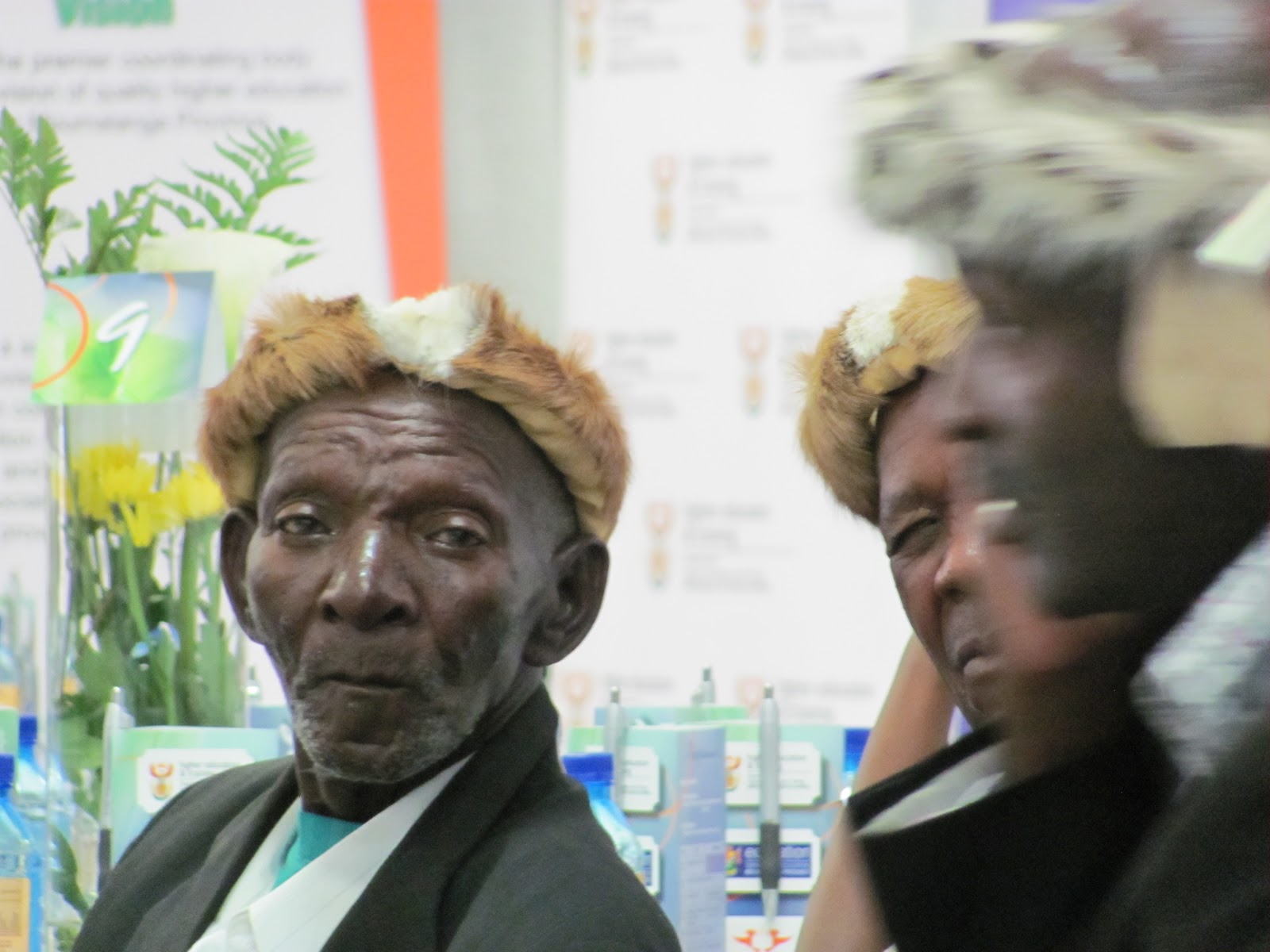
Traditional Leaders at the official opening
In Siyabuswa children mostly walk to school, laughing, playing and above all talking to each other without the aid of a cellphone!

Perhaps the local community should not be spoiled by the ills of the Digital Era and the artifacts of a consumer-driven society along Western capitalist lines.

A Traditional Leader on a cellphone
But who is to decide, since I am merely an onlooker through the lenses of my numerous digital devices.

Comments
Post a Comment