Saturday 16 March 2013

For Low-Income Kids, Access to Devices Could Be the Equalizer | MindShift

For Low-Income Kids, Access to Devices Could Be the Equalizer | MindShift

While the race in the hardware industry is perhaps most notable amongst makers of devices such as mobile phones and tablets, a seemingly unforgotten reality remains a stark reality for many: the digital divide.

With ever smarter phones, and other 'always on' devices, the policies that govern state monopolies over broadband play a damning role for the poor who remains unconnected. This reality stared me in the face when I started to engage with my first cohort of Foundation Phase Teacher students who are part of a program to establish the first new university in South Africa since the establishment of a new democratic government in 1994. In South Africa we are faced with numerous problems and inefficiencies for various reasons. Apart from the usual political upheavals and concerns about the future of democracy in the country, none is so real as the digital divide. The cost of broadband is exceptionally high in South Africa, as compared to other developing countries. The use of mobile phones to access the myriad of online services across the Internet seems pivotal, especially for the poor. However, if access to mobile phones is a problem (especially students) then the absence of access to the Internet via any other means is catastrophic.

Tuesday 26 February 2013

Bringing Higher Education to the people

The dawning of the digital era and its exhilaration after the Internet became publicly accessible have had far-reaching global consequences. It has changed society, as well as its various institutions, be it the private sector or public institutions like Education. However, soon after the initial euphoria of the Web with its interlinked hypertext that forms an endless web of rich content, a digital divide became evident. This divide, or exclusion as it is referred to in some circles, is the result of differences in the pace of adoption and the roll-out of required infrastructure. In many instances it is the last mile to the end-user that seems unbridgeable. As with other great 'break throughs' before it, technological advancements such as the Internet exacerbate inequalities, many of which have become the norm ever since the Industrial Revolution. As was the case then, the Digital Divide actually exhilarated the gap exponentially. At the heart of the exclusion of poorer nations is inaccessibility to knowledge and an inability to share in social and economic advancements associated with the Digital Age.

For many, visions of a new, equal, easily accessible virtual world in which all can participate, share knowledge, develop, and increase their capacity for a new kind of wealth generator end in disillusionment. For the most part, developing countries  have remained stuck in an industrialised old economic model, unable to become part of and benefit fully from the new economy. In a global economy, these countries provide armies of labourers, but in many instances remain outside the mainstream -- one that is driven by information and knowledge. The world is flat, but flatter in some parts than in others.

The large-scale globalisation that has its roots in Western-style colonisation experienced an unprecedented exhilaration with the introduction of an 'anywhere-anytime' economy, which wheels are oiled by round-the clock trading on a global scale. The 'anywhere, anytime' notion finally morphed into 'everywhere, all the time'. Global supply and consumer chains take 'just-in-time' manufacturing and delivery to new levels. This notion continues to impact every aspect of human society, having created new ways of 'being human' due to our 'always on' state in a highly connected world.

But there are of course parts in the world where previous promises of Utopian existences have resulted in an array of negative and often unwanted long-term consequences. One such corner can be found in South Africa. Here the effects of the Apartheid system (1948-1994) based on its notion of separate development can be found. Like so many other decisions, policies and actions before the notion of separate development was introduced as official state policy after 1948, the lingering effects of failed promises of development and the reality of under-development will be hard to reverse.

A number of events, 'flattened' the world according to Friedman in The World is Flat. With changes in the international arena, such as the end of the Cold War, and the disintegration of the USSR came a new zeitgeist, one that in many respects is intertwined with technological developments associated with the Internet, the Web and an explosion of social media networks since the turn of the 20th Century. These changes also ushered in a new era for South Africa and its people. No longer could the stand-off between the White Regime and the subjugated sections of society along racial lines continue. By 1994 a New South Africa was born, and welcomed into the international arena. However, the world into which it was welcomed had itself changed profoundly. With an end to Apartheid, the homelands that were scattered like bread crumbs all over South Africa were wiped from the map as if by a big hand. The country was once again united and areas like Siyabuswa in Kwa-Ndebele, Venda, and Transkei are part of a united South Africa.

Finally, nearly two decades after the dawning of a new South Africa, a once proud creation of the Apartheid government has been put to new use. The Ndebele College of Education that was meant for 'seperate development' in the once separate homeland of Kwa-Ndebele not too far from Pretoria now houses the new Faculty of Education for the first new university in south Africa since 1994. The campus has aptly been renamed to 'Teacher Education Campus, Siyabuswa'. The academic programme will for four years be the responsibility of the University of Johannesburg. A major sponsor for student fees for the first 100 students is the European Union.

The NEW!

The old


The whole area is characterised by the long-term negative effects of separate '(non-)development' during the years of Apartheid. Under-development and poverty in this typical rural area are exceptionally rife, while the effects of the Digital Divide are evident everywhere, including local schools. However, in the midst of this community a new institution of higher education has been established with the hope of sharing in the spoils of development in a country that is part of a global village. A gate is opening and by becoming part of this global village we too can learn from the locals, many of whom have managed to retain their cultural roots, untouched by a fast-paced modern society.


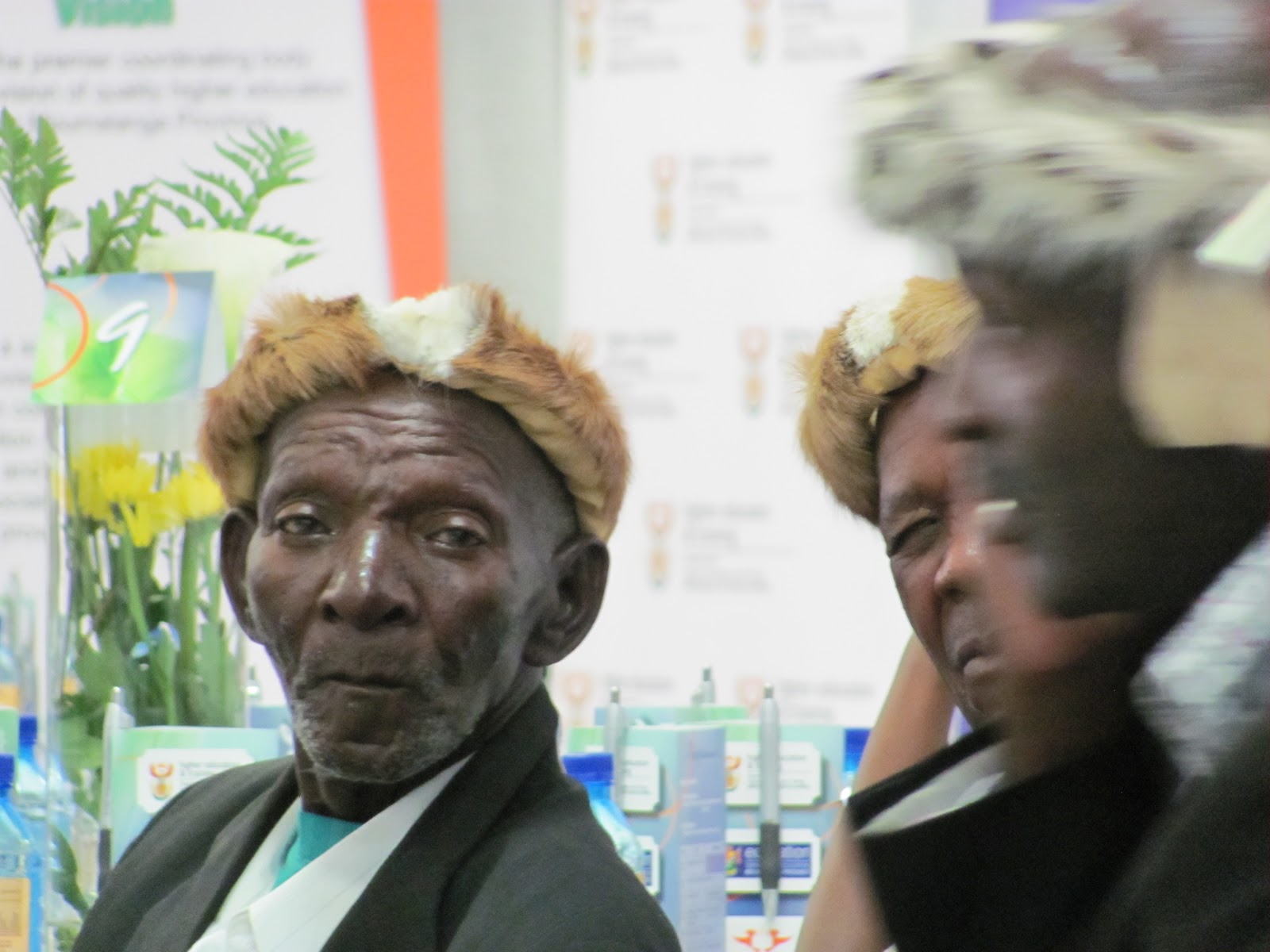
Traditional Leaders at the official opening


In Siyabuswa children mostly walk to school, laughing, playing and above all talking to each other without the aid of a cellphone!


Perhaps the local community should not be spoiled by the ills of the Digital Era and the artifacts of a consumer-driven society along Western capitalist lines.

A Traditional Leader on a cellphone


But who is to decide, since I am merely an onlooker through the lenses of my numerous digital devices.

Thursday 31 January 2013

Making friends: The hidden structures in social groups

I am priviledged in the sense that I am part of the establishment of a new campus -- one that will become the new University of Mpumalanga. My gaze, however, is less on the promise of a new university and the voids it will fill, but more on the first intake of students for the Foundation Phase.

We don't know the students, and they don't know us. They don't know each other, either. So, apart from leaving it to themselves to come to know each other, institutions all over the world use all kinds of activities to ensure that individuals settle into their new environment. Above all, the aim of these activities is for people to learn how to start functioning as a group -- as a collective.

My gaze remains fixed on the actions - the individuals who stop participating and choose to become onlookers; the energy and the rhythm of the games - traditional games that I guess many city dwellers have forgotten about. I was surely reminded of a few games I use to play when I was small. That's another bonus for Foundation Phase. Its our job to play since in Grade R to 3 children learn predominantly through play.

Which brings me back to networks: the groups we form, the associations we make, the ties we form all serve a purpose. And another point. At some point in school we stop playing and learning becomes boring, tedious and difficult. Why not focus more on edutainment? And what about the workplace. If we learn new things, when we get challenged and need to solve a problem -- why not play more? Solutions are crafted when minds are challenged and what better way to do it than through play.

... so, when making new friends, or forming alliances... finally energy resides in the network and behaviour will shape the network as much as the network will shape individuals and their behaviour. Luckily we have Social Network Analysis to unearth the characteristics of networks, which aids with our understanding of dysfunctionalities within groups. It also shows who holds power and influence... Can't wait to start charting the ties between nodes.

The essence of being

It took considerable courage for me to put down everything, block out the noise and pick up the book. Its overcast outside, the kind of weather one would expect to encounter in London NOT Johannesburg in early summer. Its Saturday and I don't need to be at work. Exhausted after a week of traveling to the school where I try my best to teach students for whom school seems an unnecessary stumbling block, staying in bed a bit longer than usual was especially welcome.

I recently received five copies of Ghost Boy by Martin Pistorius. Reading Ghost Boy was not going to be easy. Martin Pistorius's life story is a moving one, since he fell ill as a child and became trapped in an unresponsive body. Yet, once he came out of his coma no-one actually knew that he was  intelligent and completely aware of his surroundings. In fact, he could follow conversations. Being placed in front of a TV for long periods meant that he was "re-schooled". While other stimuli like the radio also sometimes filled his days, it only became apparent much later that there was a real boy inside the awkward-looking body. However, Martin couldn't react and communicate - it was as if he didn't exist. Few people would actually look at him or speak to him directly, apart from his parents and of course a few care-takers that assisted him medically.

In Ghost Boy, Martin describes his journey from falling ill and the slow progress in getting his body to come alive again. The frustration of learning how to communicate makes for compelling reading. Martin's progress in this regard is closely linked with the development of artificial communication made possible by progress in computer technology and work at the University of Pretoria, amongst others.

Its a story of a life as a ghost boy that nearly became trapped in a permanent state of lock-down. It is, however, also a story of the triumph of the human spirit in the wake of seemingly insurmountable obstacles.

Being locked down in an unresponsive body and a seemingly inability to escape from this state underlines the one thing that sets humans apart: we communicate not only what is real, but also what we imagine. Martin's vivid descriptions reminded me once again of this distinguishing factor. However, what could have easily become a heavy script is often well-balanced with a light-heartedness stemming from Martin's long intelligent 'observer status' unknown to the people who came into contact with him or merely passed through his immediate environment. In his book Martin manages to reflect upon his experiences in a way that is inspiring and gripping. He does this in a style that is undramatic without diminishing the real horror of his condition, especially revealing the truth about the abuse he suffered at the hands of some of the caretakers.

Thank you Martin for not giving up.

Friday 18 January 2013

Tertiary Education in South Africa - Some developments

Following the developments of Education in South Africa

Education in South Africa - Info SA

I am fortunate enough to be part of a new development in tertiary education. Efforts to establish a new university in Mpumalanga has brought together a number of roleplayers and stakeholders which has resulted in the launch of the Teacher Education Campus in Marble Hall.

The University of Johannesburg provides the academic program -- one that is unique in the sense that it involves a teaching school. Initially introduced at the Soweto Campus, this approach to Teacher Training proves to be successful. Similar in principal to an academic hospital for trainee doctors, the teaching school offers teachers-to-be the opportunity to observe a fully functional, real-world school.

The establishment of a new university in the Mpumalanga province is an opportunity to be based in a rural part of South Africa. The aim with this multi-stakeholder initiative is to train students from rural areas in the hope that they will return to schools in rural areas. The first program is at the Foundation Phase, Grade R to Grade 3. Often, once students from the countryside go to urban-based universities where they also experience the Big City, they are loathe to return to the country-side. It is here, in fact, where South Africa needs young, new-generation, inspiring teachers the most.

Other stakeholders in the Teacher Education Campus at Siyabuswa include the National Institute of Higher Education (Mpumalanga), the National Department of Higher Education and Training and the Mpumalanga Department of Education. In time staff, including myself, will use the University of Johannesburg's offical Social Media Channels. However, I will also share experiences and my personal views on my personal blog, thereby building an online artifact.

Thursday 30 August 2012

Hope, aspirations, attitudes, perceptions and long-gone memories

The yellow piece of paper with its big fat black letters printed in bold is neatly laminated. Stuck on the side of the classroom cupboard it is meant to be seen as students walk into the class. But they barely do, since they are too busy with their own lives. The yellow poster proclaims our current president's words:

"Children should be in class, on time, learning, being respectful of their teachers and each other, and DO THEIR HOMEWORK" - President Jacob Zuma (7 August 2009)

Hmmm... sounds like presidential support for what teachers are trying to achieve day in and day out, lesson after lesson... Alas, with little success it seems. My Grade 11s wrote a cycle test three days ago. Yesterday I started marking. The first paper I opened screamed at me! The student wrote "useless dupless" all over the question paper. I could not help but take it personally.  The president's words brought some relief. Or did it really? Indeed, can it? The president is far-removed from reality, and so are his ministers and the officials further down the food chain. In the end it is me and the direct, face-to-face interaction with each and every individual learner, including the scores of students who do not want to learn. Its actually laughable to what lengths they will go to find ways of avoiding being taught.

This is starkly juxtaposed by the remarkable story of Martin Pistorius (distant family of Oscar Pistorius who himself is world-wide inspiration). Martin's story, told in 'Ghost Boy', is one of an intelligent mind trapped in an unresponsive body. Ive ordered a few copies (I like paper -- epubs have their place) and can't wait to start reading the story of his remarkable journey. I also can't wait to give a few away as worthwhile reading to those whom I know need to read a story like this.

So, here we sit with two extremes. On the one hand we use money, energy, effort, resources, talent, time, knowledge, insight, experience, etc in an effort to raise the next generation that must stand tall among nations... Sadly, the sea of ignorance that meets me is overwhelming. What I see on a daily basis is that the majority of the current student corps at the institution where I currently (try to) teach shows a complete lack of work ethic, morals, (self)-discipline and above all respect. Wires have become crossed somewhere and things are going haywire. Instead, what have become prevalent at my educational institution where no child is challenged in a physical or mental way are random drug tests, suspensions (week long, few days), disciplinary hearings, books left at home, and so forth. This ought to have been a place where minds come together, where engagement leads to learning. I cannot help but think of the complete and utter waste... and that we are doing something wrong somewhere.

And the other extreme? To me people like Martin represent that which I thought ought to be a universal characteristic of the human spirit: People who must overcome the most incredible odds in order to live a meaningful life (in their terms) -- and in fact excel in what they aim to achieve.

Thank you Martin Pistorius... Thank you for being!

Tomorrow, like all other mornings, I will take to the highway at sunrise, and drive halfway around Johannesburg to go and teach, inspire, and help develop young minds. I will look beyond the lost souls, the wondering minds, the frustration, and the archaic school system that is out of pace with the real world... I will take care of every child in front of me, for they are not mine. I promise to leave none of them behind.

Sunday 26 August 2012

Yes I can... we can, you can too!

With the amount of work to be completed by the end of term heaping up like a mountain it seems impossible to accomplish. 'A bridge too far', 'A mountain too high'... Given the fact that I am a student too, it means that my term as teacher more or less coincides with my term as student. Assessment, marking, writing exams, marking others' cycle tests, and so forth... Im sure you get the picture.

... and then there is the prospect of new plans... new challenges for the year ahead -- all in the name of reviving school-based education. It was particularly apt then that I started to look for inspiration. It takes a lot of energy and will power to mark a stack of papers... all while I am thinking of my own examination that is looming. It takes even more guts and raw courage to put a bold plan on the table in the hope that management will accept it as a way to move forward. See, I have a deep-seated belief that education -- throughout the whole spectrum in South Africa -- is in deep trouble. At least at secondary school level we need a revival and renewal. We cannot carry on teaching the way that we have been taught. Neither can I merely add more expensive toys and still carry on in the same way... Education needs to be reloaded / refreshed / rebooted ... hence the journey to introduce Moodle as a framework to deliver content and assessment, and above-all to create a community of learners and teachers that will hopefully stretch beyond the borders of our school.

So, just when I thought that too much is going on at once and that I have little chance of getting things done on time I turned to YouTube; by chance I came across Oscar Pistorius' Nike Advertisement... Ive forgotten about it...


If Oscar can do this -- with no legs -- can I also, in my own way get to those learners in my class who refuse to learn? Is it possible to connect with them in a way that will speak of trust and not distrust? Can I help facilitate and rekindle curiosity and an eagerness to learn amongst all my students, especially those who are 'switched off' and bent on causing as much disruption as possible? I don't know. To you Oscar... I sure am going to try... You see, I also know all about trying!

Wednesday 22 August 2012

What happened to the will to learn? ... And the right to teach?

During the past week or so I have become acutely aware of the lack of a culture of learning amongst some of the pupils I teach. Still continuing with my journey of discovery into the state of Government-school education in an urban school in Johannesburg (South Africa), I am completely taken aback by the range of excuses I must listen to:

  • My textbook is too heavy and I don't want to carry it around the whole day
  • I don't have my books here today
  • Why must I take my bag off my table or open any books?
  • Sir, the exercise you have given us to complete for marks is unfair. Why must I now learn MovieMaker? I thought we will only write a cycle test and a class test. This is really unfair. (This is so strange, considering Sir Ken Robinson's views that schools are killing creativity.)

and so the list goes on... (I feel compelled to have video cameras installed in my classroom since this is the kind of footage that parents need to see). I think, once I have collected enough evidence, I can show it to our President. President Zuma said emphatically at the beginning of this academic year that learners must be in class, on time, learning. (My next letter will be to the President...)

I cannot help but be very very worried about the future of our country if the attitude of these students at secondary school level (ages 12-18) is anything to go by. (I feel even more sorry for the future employers) As I have stated in my previous posts, there is surely something seriously wrong with South African's educational system. Systems are, however, driven by people. We can have the most perfect educational system on paper, yet fail dismally since the attitudes of those we wish to serve are all screwed up. I fail to understand what the reasons are for a complete lack of interest in new knowledge or the absence of an eagerness to learn. I truly do.

In the meantime this camel's back is starting to bend in the wake of events such as:

  • The cable of my PC's mouse got cut (despite being an old computer, at least I have one...)
  •  A female student starts to abuse me verbally after I request her to pay attention to the lesson. I am covering work that will be in the up-coming test, after all.
  • Two female students, after I have spoken to them about their lack of attention in class and not doing any work, have now embarked upon a complete 'ignore the teacher' attitude

I cannot help but wonder what is going on at these students' homes and whether there is any form of discipline or respect. I wonder what morals and ethics are taught and whether the parents (or guardians) are actively instilling a work ethic. I cannot, however, take the place of parents and teach their children manners and respect. My thoughts go further... are these students' attitudes a reflection of South Africa's new growing culture that is characterised by widespread corruption, fraud and a general disrespect for the law?


Despite all these negative experiences, I refuse to become a typical disciplinarian that shouts, screams etc... I will remain the dedicated teacher that I think I am... and focus on teaching. After all, my country's constitution protects me and my right to dignified work. Perhaps its time to test our country's constitution and see if it lives up to its promise. All I truly want to do is teach my subject matter with dedication and in ways that are inspiring and creative. I get my inspiration from others like Sir Ken Robinson. Like him, I truly believe its time for a paradigm shift in education.